
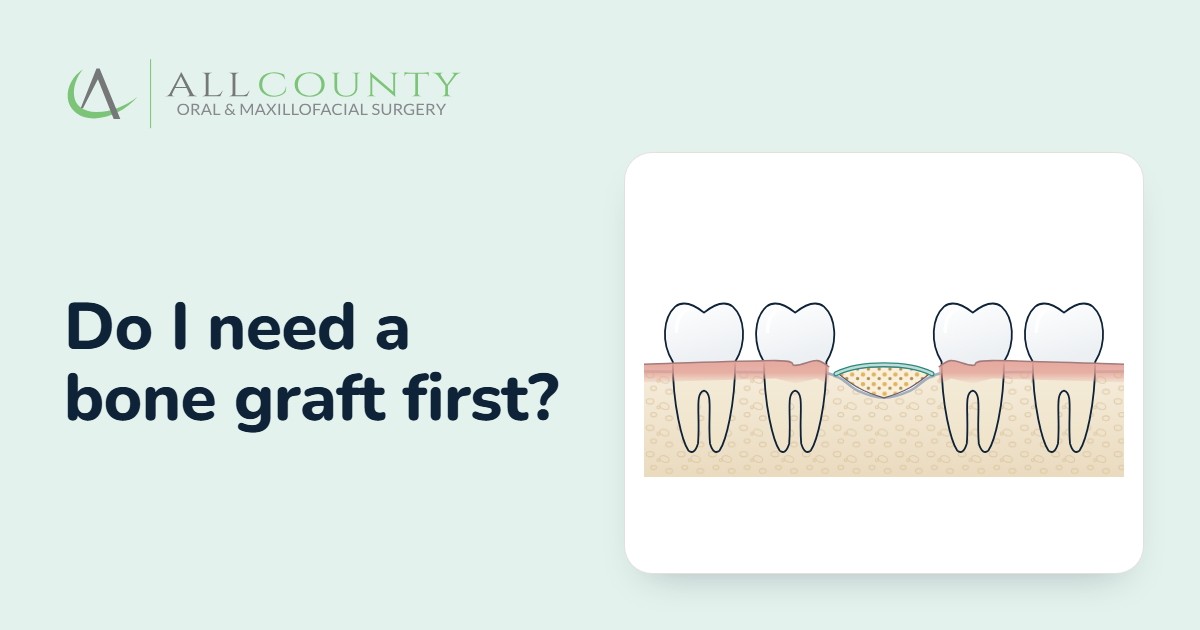
What this post answers. This article explains why jawbone resorbs after a tooth is lost, how a 3D scan determines whether enough bone remains, the three principal grafting procedures, and what grafting means for comfort, treatment time, and the long-term success of an implant.
A bone graft before implants is a common part of implant planning, and the recommendation often raises concern that a major additional surgery will be required. In most cases, it will not. At All County Oral Surgery, bone grafting is a routine part of implant care, usually performed in the office, and it frequently provides the foundation an implant needs for long-term success.
The short answer. An implant requires a sufficient volume of healthy bone to remain stable. After a tooth is lost, the bone in that area often resorbs. A 3D scan measures exactly how much bone remains. When the volume is sufficient, no graft is needed. When it is not, a graft restores the bone, sometimes during the same procedure as the implant. Many patients do not require a graft at all.
Why jawbone resorbs after a tooth is lost
The portion of the jaw that holds the teeth is called the alveolar ridge. Its health depends on function. During chewing, the tooth roots transmit pressure into the surrounding bone, and that pressure signals the body to maintain it. When a tooth is lost, the signal stops. The ridge gradually becomes narrower and shorter, a process called resorption, and the adjacent teeth can begin to drift into the space. Most of this change occurs during the first year after tooth loss. For this reason, surgeons at All County Oral Surgery prefer to discuss tooth replacement before an extraction rather than after.
Other conditions can also reduce the available bone, including periodontal disease, infection at the root of a tooth, injury, and long-term denture wear. In the upper back jaw, the maxillary sinus lies directly above the roots, so the bone in that area may be thin from the outset.
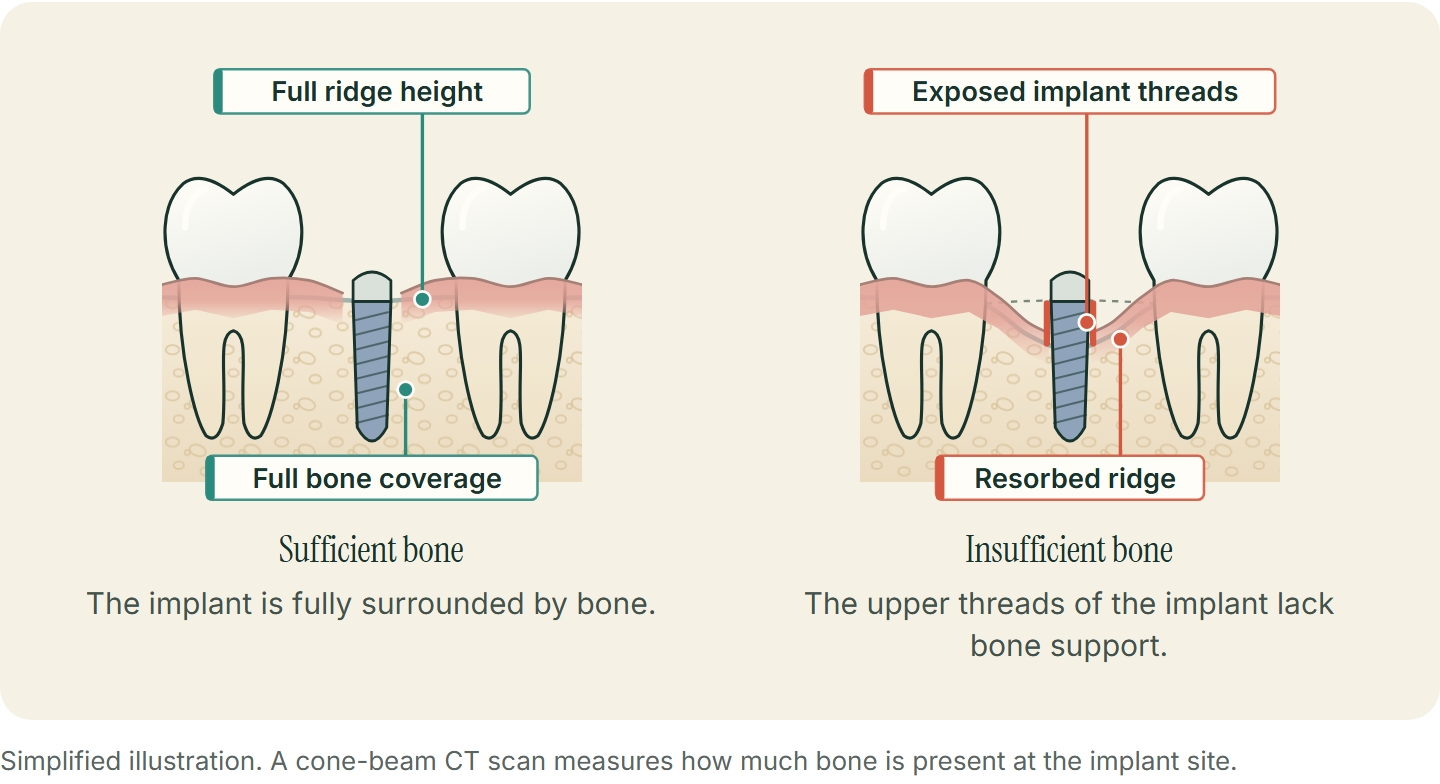
The illustrations show why bone volume matters. An implant replaces the root of a tooth, and bone must grow tightly against its surface to hold it in place. This bonding process is called osseointegration. When the ridge has resorbed, part of the implant would sit above the bone without support. A graft addresses this by restoring the bone before, or at the same time as, the implant is placed.
How the need for a graft is determined
The decision is based on measurement, not estimation. At the consultation, your surgeon at All County Oral Surgery takes a cone-beam CT scan, a three-dimensional X-ray, in the office. The scan measures the height and width of the bone from every angle and shows its relationship to the nerve in the lower jaw and the sinus in the upper jaw. A standard X-ray is two-dimensional and cannot show the width of the ridge; the 3D scan can. Your surgeon reviews the images with you on screen.
The scan generally leads to one of three conclusions. The bone may be sufficient, and the implant can be placed without a graft. The bone may be slightly deficient, in which case a small graft can often be placed during the same procedure as the implant. Or the bone may be too thin or too short, in which case the graft is placed first and the implant follows after healing. A recent 3D scan from your dentist can be sent to our office and may make a new scan unnecessary. Our images can likewise be shared with your dentist, so the entire care team works from the same information.
Learn whether you have enough bone
A 3D cone-beam CT scan at your consultation shows exactly how much bone is present, so you leave knowing whether a graft is needed, with a written estimate for the plan.
Recommended surgeons: Dr. Ross Chavkin (founder of All County Oral Surgery), Dr. Nicholas Kim (DMD, MD; implants and advanced bone grafting), and Dr. Natalie Yam (board-certified periodontist).
Request a consultation or call the office nearest you.
The three principal grafting procedures
A bone graft provides a framework on which the body forms new bone. Graft material is placed where bone is deficient, and over the following months the patient’s own bone grows into and around it until the graft becomes part of the jaw. The appropriate procedure depends on where bone is missing and how much is needed. Bone augmentation is a particular focus of Dr. Ross Chavkin, who founded All County Oral Surgery, and all three procedures below are performed by our team.
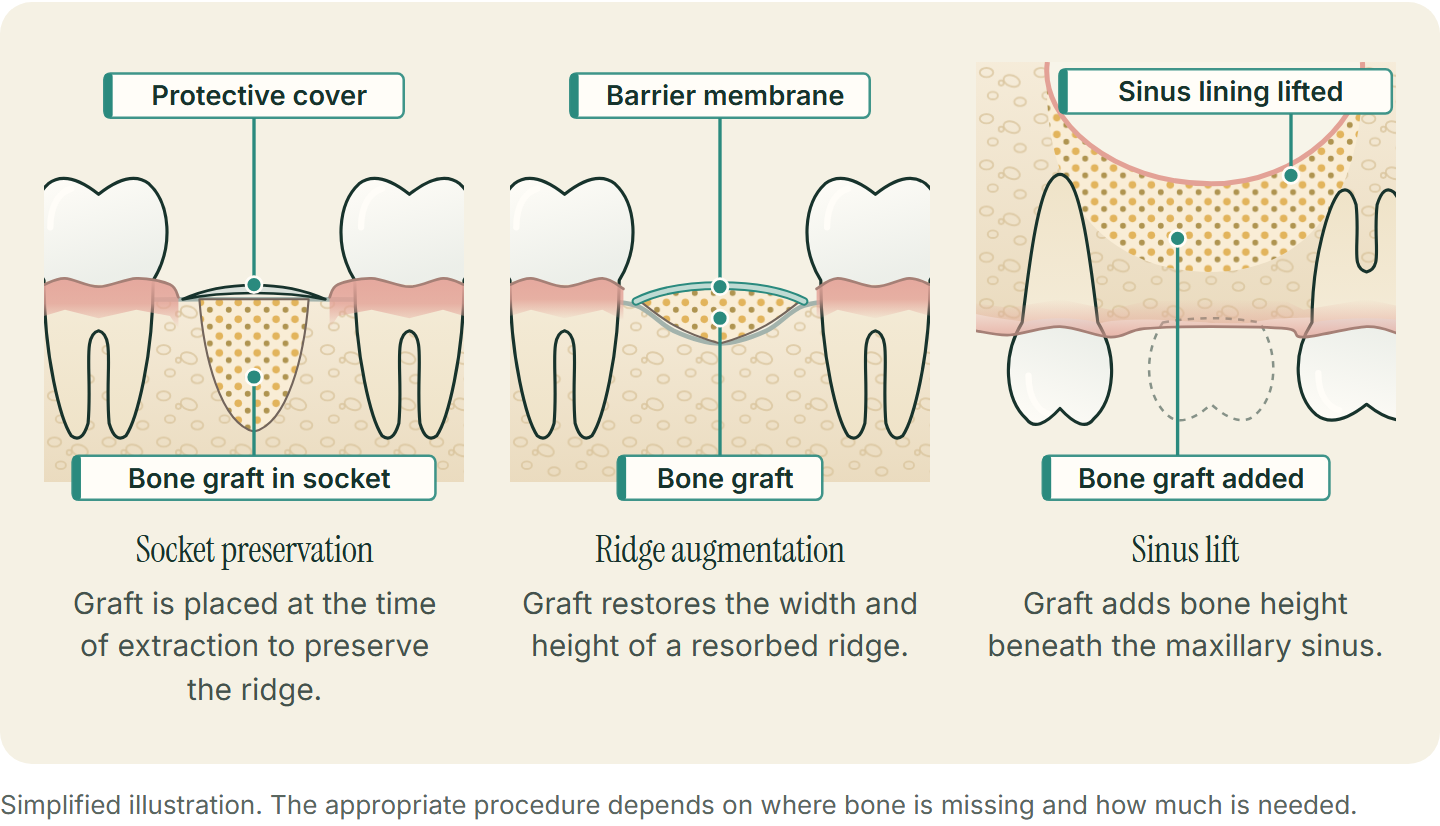
Socket preservation is performed at the time of extraction. Graft material is placed in the empty socket and covered with a thin protective layer. This preserves more of the ridge’s height and width than allowing the socket to heal on its own, and it often prevents the need for a larger graft later. Patients who are having a tooth removed and may want an implant should ask about socket preservation before the extraction.
Ridge augmentation restores a ridge that has already resorbed. The surgeon opens the gum, places graft material along the deficient portion of the ridge, and covers it with a barrier membrane. The membrane holds the graft in place and prevents gum tissue from growing into the space where bone should form, an approach called guided bone regeneration. The gum is then closed over the site with sutures.
A sinus lift, or sinus augmentation, increases bone height in the upper back jaw beneath the maxillary sinus. The surgeon gently elevates the thin membrane that lines the sinus floor and places graft material beneath it. Because the procedure takes place below the sinus lining, the sinus continues to function as before.
Graft material may come from the patient’s own body (an autograft), from a tissue bank (an allograft), from specially processed animal bone (a xenograft), or from a synthetic material. Each has distinct properties. The patient’s own bone contains living cells, while the other materials serve as a framework into which new bone grows. Your surgeon explains which material is appropriate for your case and why.
Effect on the treatment timeline
A small graft placed during the same procedure as the implant adds little or no time to treatment. When the graft is placed first, the bone generally requires several months to mature before the implant can be placed, depending on the size of the graft and the material used. The implant then heals for several additional months before your dentist places the final restoration.
This additional time supports the long-term result. An implant placed in sufficient bone has the support it requires, while an implant placed in deficient bone carries a higher risk of failure.
What to expect
Most grafts are performed in the office under local anesthesia, and IV sedation is available for patients who prefer it. Patients typically feel pressure rather than pain during the procedure. Swelling and soreness are expected for several days afterward, similar to recovery from an extraction. Small particles of graft material may be noticed in the mouth during the first few days, which is normal. After a sinus lift, patients are asked to avoid blowing the nose forcefully during healing. Every patient receives written instructions specific to the procedure and a number to call with any concern.
Common questions
Is a bone graft painful? The procedure is performed under local anesthesia or sedation, so patients typically feel pressure rather than pain. Afterward, the area is sore for several days, comparable to an extraction.
How is the need for a graft determined? Only a scan can determine it. Many patients who expect to need a graft are found to have sufficient bone.
Can the graft and the implant be placed at the same time? In some cases. This depends on the amount of bone present at the outset, which the scan shows.
Does a bone graft change the cost of an implant? Yes. A graft is an additional procedure, and it appears as its own line on the written estimate.
Can a missing tooth be replaced without a graft? In some cases. A bridge or a partial denture does not depend on bone in the same way an implant does. Your dentist can help you compare these options with an implant.
Why patients choose All County Oral Surgery for bone grafting
The success of an implant depends on the bone that supports it, and bone grafting is performed by several members of our team. Dr. Chavkin earned his dental degree at the University at Buffalo and completed his residency at SUNY Downstate / Kings County Hospital in Brooklyn. He practices every aspect of oral and maxillofacial surgery, with a particular focus on bone augmentation and implant surgery, and he works alongside surgeons and periodontists who perform these procedures as well. Dr. Natalie Yam is a board-certified periodontist, trained at Harvard, who performs bone augmentation and sinus lifts. Dr. Taly Argov has more than 15 years of periodontal practice, concentrating on regenerative procedures that rebuild bone and gum tissue.
Each plan for bone grafting and dental implants is built on 3D imaging and includes a choice of anesthesia. Consultations are available at any of the nine offices across New York City and Long Island. When the surgical phase of treatment is complete, the findings are sent to your dentist, who places the final restoration.
Uncertain whether you have sufficient bone for an implant? Request a consultation. Your scan will provide the answer, and you will leave with a clear treatment plan.
This article is general information and is not a substitute for a consultation with an oral and maxillofacial surgeon or periodontist. Your own scan and examination determine the treatment you need.