
What this post answers. This article explains what a dry socket is, how it differs from normal healing, which factors increase the risk, how to protect the healing socket, and how a surgeon at All County Oral Surgery reduces that risk before surgery and treats a dry socket if it develops.
A dry socket is one of the most common complications after a tooth is removed. It typically appears two to four days after the extraction, when pain that had been improving returns with greater intensity and often spreads toward the ear. A dry socket is not dangerous, and it responds quickly to treatment. At All County Oral Surgery, our surgeons work to reduce the risk before surgery and treat a dry socket promptly if it develops.
The short answer. After a tooth is removed, a blood clot forms in the empty socket and protects the underlying bone while it heals. A dry socket, clinically called alveolar osteitis, occurs when that clot breaks down or is dislodged too early, leaving the bone exposed. The condition is painful, but it is not an infection. Cleaning the socket and placing a medicated dressing usually brings relief within hours.
How a socket normally heals
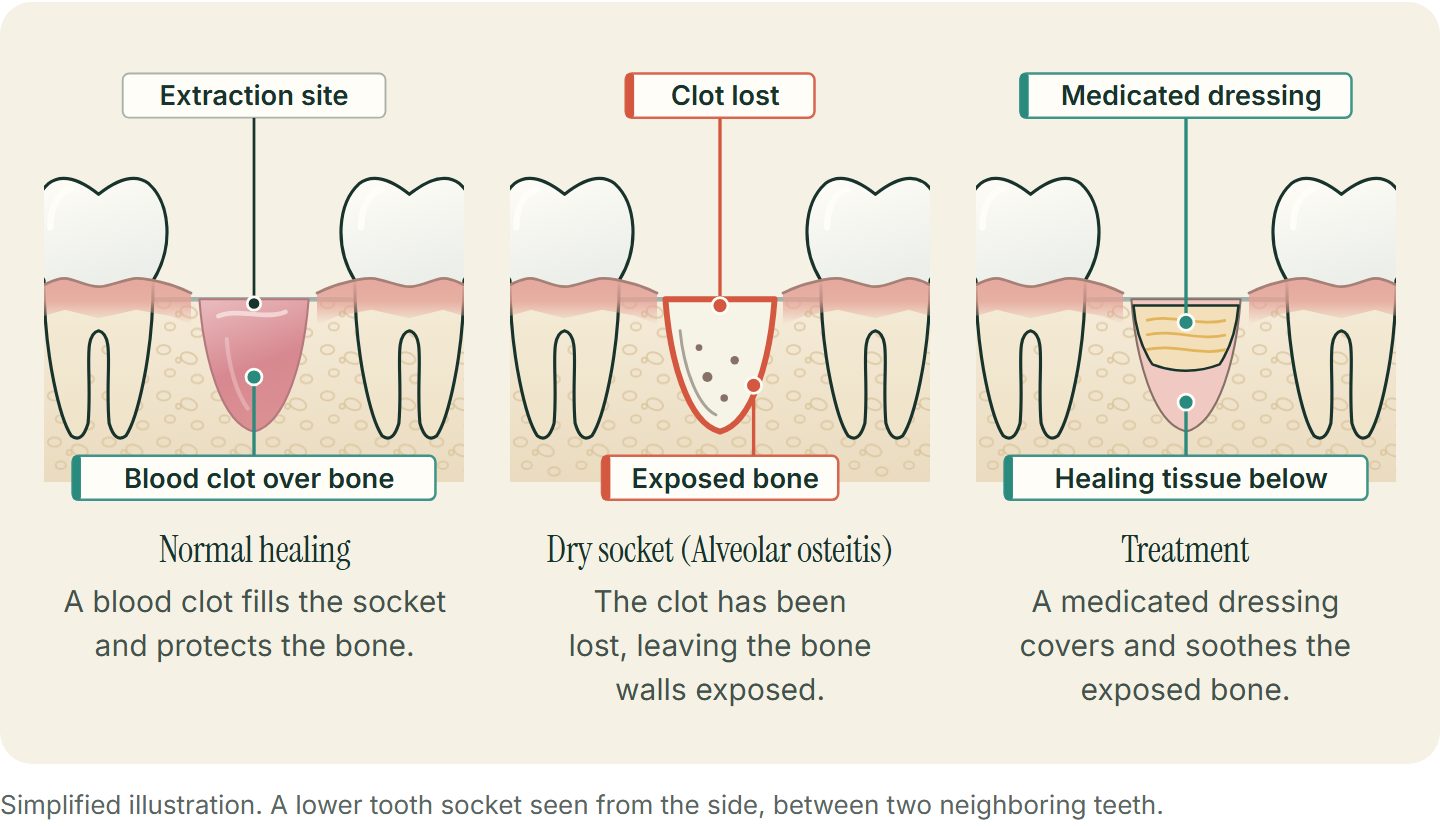
Removing a tooth leaves an opening in the jawbone called a socket. Blood fills the socket within minutes and forms a clot. The clot is the first stage of healing. It covers the bone, seals out food and bacteria, and provides the framework on which new tissue forms. Over the following weeks, gum tissue closes over the opening, and new bone gradually fills the socket from the base upward.
A dry socket develops when this first stage fails. If the clot is lost during the first few days, the bone walls of the socket are exposed to the mouth. Bone contains nerve endings, and exposed bone is highly sensitive. The illustrations below show normal healing, a dry socket, and the standard treatment.
Distinguishing a dry socket from normal healing
Some discomfort after an extraction is expected. The distinguishing feature is the course of the pain over time. Normal post-operative pain is greatest during the first one to two days and then decreases each day. Pain from a dry socket follows the opposite course. It typically begins, or returns more strongly, two to four days after the extraction. The pain is deep and throbbing and can radiate to the ear, eye, or neck on the same side. Many patients also notice an unpleasant taste or odor, and the socket may appear empty, with pale bone visible where the clot had been.
Fever, pus, and steadily increasing swelling are not characteristic of a dry socket. These signs can indicate an infection, which requires different treatment, and should be reported to your office the same day.
Planning an extraction?
At a consultation, your surgeon at All County Oral Surgery reviews your health history and the risk factors for dry socket before surgery. You leave with a written estimate and written aftercare instructions.
Recommended surgeons: Dr. Ross Chavkin (founder of All County Oral Surgery), Dr. Gregory Cooke (DDS, MD; six-year residency at Mount Sinai), and Dr. Branden Brar (residency at Boston University and Boston Medical Center).
Request a consultation or call the office nearest you.
Factors that increase the risk
A dry socket can follow any extraction, but certain factors increase the risk. It occurs more often after the removal of lower wisdom teeth, particularly impacted ones, because those procedures tend to be more involved. Smoking and vaping raise the risk through both suction and the chemicals they contain. Any action that creates suction or pressure in the first few days, such as drinking through a straw, spitting, or rinsing forcefully, can also dislodge the clot. A previous dry socket and the use of oral contraceptives or other hormone medications are associated with a higher risk as well.
For this reason, prevention begins at the consultation. Your surgeon at All County Oral Surgery reviews your medical history, medications, and habits before the procedure is scheduled. Patients who smoke receive guidance for the days surrounding surgery. A history of dry socket should always be reported, as it informs both the surgical plan and the aftercare instructions.
Protecting the clot after surgery
The first few days after an extraction are the most important, because the clot is most fragile during this period. Smoking and vaping should be avoided; where complete abstinence is not possible, even a short pause reduces the risk. Straws and spitting should be avoided, and liquids should be allowed to drain from the mouth over a sink. Rinsing is not recommended on the day of surgery. From the following day, a gentle rinse with warm salt water after meals is appropriate: the water is held in the mouth and then allowed to drain, without swishing.
Soft foods served cool or lukewarm, such as yogurt, eggs, and mashed potatoes, are recommended. Food should be chewed on the opposite side of the mouth. Brushing should continue on the other teeth while the extraction site is avoided for the first few days. Medication should be taken on the schedule your surgeon provides, since pain is more easily prevented than relieved. Every patient at All County Oral Surgery receives written instructions for their specific procedure, and the complete aftercare guide is available online.
How a dry socket is treated
Treatment is brief, and most patients notice improvement the same day. The surgeon gently irrigates the socket to remove food and debris, then places a small medicated dressing inside it. The dressing covers and soothes the exposed bone. Many patients experience significant relief within one to two hours. The dressing may need to be replaced every one to two days until the pain subsides. Beneath it, the socket continues to heal, although more slowly than it would otherwise.
A dry socket does not need to be endured. Call your office as soon as the signs appear, and the team will arrange a time for you to be seen. All County Oral Surgery has nine offices across New York City and Long Island, so an office is usually close to home.
When to call your office
Contact your All County Oral Surgery office if pain increases rather than decreases after the first two to three days, or if your prescribed medication no longer controls it. Call as well for an unpleasant taste or odor that persists, bleeding that does not slow after 30 minutes of firm pressure on gauze, a fever, or swelling that continues to increase. Outside office hours, see how to reach us.
Common questions
Is a dry socket an infection? No. A dry socket is a disruption of healing caused by the loss of the protective clot. An infection typically produces fever, pus, or increasing swelling, and it is treated differently.
Does a dry socket heal without treatment? It does heal over time, but the pain during that period can be severe. Treatment makes recovery considerably more comfortable.
How can normal pain be distinguished from a dry socket? The trend is the key indicator. Pain that decreases each day is normal. Pain that increases after the second or third day should be reported to your office. Your written instructions describe the expected course of recovery.
Does a dry socket affect future implant treatment? Once the socket has healed, an implant can still be planned. Patients considering an implant should ask about a bone graft before implants, which can sometimes be placed on the day of the extraction.
Why patients choose All County Oral Surgery for extractions
Effective management of a dry socket begins before surgery and continues after it. Our nine oral and maxillofacial surgeons perform tooth extractions and wisdom teeth removal. Each completed a hospital residency in oral and maxillofacial surgery, and four also hold medical degrees. Dr. Gregory Cooke, for example, completed a six-year oral and maxillofacial surgery residency at Mount Sinai. Consultations are available at any of the nine offices across New York City and Long Island.
Dr. Ross Chavkin, who founded All County Oral Surgery, considers listening to his patients’ concerns and addressing them with professionalism and compassion a source of great pride. That principle guides every stage of care: a review of risk factors before surgery, written instructions specific to each procedure, and an office available to patients whose healing does not proceed as expected.
Need a tooth removed? Request a consultation at the office nearest you.
This article is general information and is not a substitute for care from an oral and maxillofacial surgeon. Follow the written instructions your surgeon provided, and contact the office with any concern.