
What this post answers. Whether a wisdom tooth requires removal depends on its position. This article explains the four positions a wisdom tooth can take, the damage an impacted tooth can cause to the teeth in front of it, and how a surgeon at All County Oral Surgery evaluates each tooth before making a recommendation.
Do all four wisdom teeth need to come out? Not necessarily. The answer depends on the position of each tooth in the jaw, and it can differ from one corner of the mouth to another. At All County Oral Surgery, each wisdom tooth is assessed on its own, and a careful evaluation often shows that some can be kept.
The short answer. A wisdom tooth that is upright, fully erupted, and easy to clean can often remain in place for life. A tooth that is impacted, tilted, or only partially erupted is usually better removed, because it can damage the teeth in front of it before it causes any pain. At All County Oral Surgery, your surgeon reviews each of your four wisdom teeth and makes a separate recommendation for each one.
Why each wisdom tooth must be assessed separately
Wisdom teeth are the third molars, the last teeth to develop, with one in each back corner of the mouth. They typically attempt to erupt between the late teens and the early twenties. By that age, the jaw often has little space left behind the second molars. Whether a wisdom tooth erupts normally depends on the length of the jaw, the angle at which the tooth develops, and the alignment of the teeth in front of it.
These factors can differ between the left and right sides and between the upper and lower jaws. One wisdom tooth may erupt upright while the opposite tooth becomes impacted. For that reason, a single recommendation for all four teeth is rarely appropriate. The four positions below are the ones oral surgeons encounter most often.
When a wisdom tooth can be kept
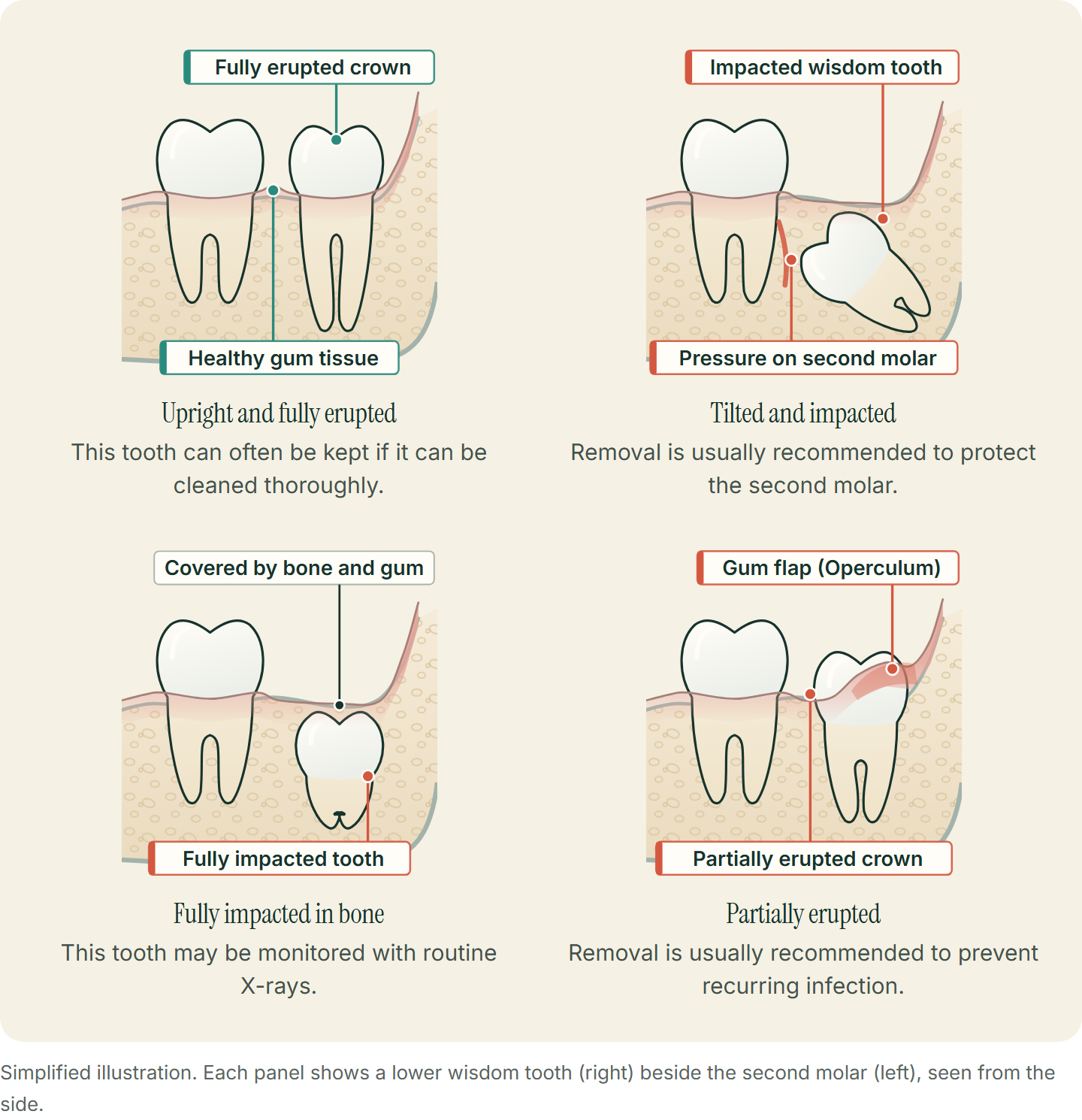
A wisdom tooth that is fully erupted, upright, and in contact with the opposing tooth can function like any other molar. The deciding factor is whether it can be kept clean. When a toothbrush and floss reach every surface of the tooth and the surrounding gum tissue remains healthy, the tooth can usually stay. Your dentist then checks it at routine examinations.
A tooth that is fully covered by bone, as shown in the “Fully impacted in bone” panel, may also be left in place when it shows no signs of disease. This approach is called monitoring. The routine X-rays taken by your dentist allow any change around the tooth to be detected early, at which point the recommendation can be revisited.
Find out which wisdom teeth need attention
At a consultation, your surgeon assesses each of your four wisdom teeth on your X-rays, explains the recommendation for each one, and reviews your anesthesia options. You receive a written estimate, with no obligation to schedule.
Recommended surgeons: Dr. Ross Chavkin (founder of All County Oral Surgery), Dr. Jason Tan (trained in dental anesthesiology and oral surgery), and Dr. Roxanne Oghaz (DDS, MD; six-year residency at Mount Sinai).
Request a consultation or call the office nearest you.
When removal protects the teeth you keep
The “Tilted and impacted” and “Partially erupted” panels show the positions most likely to cause harm. In both, the concern extends beyond the wisdom tooth itself to the second molar in front of it and to the surrounding gum tissue.
Tilted, impacted teeth. A wisdom tooth that develops at a forward angle presses its crown against the back of the second molar, one of the most important chewing teeth. Where the two teeth meet, the gum separates from the tooth and forms a narrow pocket that cannot be reached with a toothbrush. Plaque and food accumulate in this pocket. Over time, this can cause decay low on the back of the second molar, near the root, where it is difficult to detect and difficult to restore. The same pocket can also lead to loss of the bone that supports the second molar. Because these changes rarely cause pain until they are advanced, protecting the second molar is often the primary reason for recommending removal.
Partially erupted teeth. When a wisdom tooth breaks only partly through the gum, a flap of tissue called an operculum remains over the back of the crown. Food and bacteria collect beneath this flap, and the surrounding gum can become inflamed and infected. This condition, called pericoronitis, tends to recur. It is often the first symptom a partially erupted wisdom tooth produces.
Removal is also recommended when an orthodontist requires the space, or when decay or gum disease has already developed on the wisdom tooth. In each case, the purpose is to protect the teeth that will remain for life.
Removing some or all four, and the role of age
When only one or two wisdom teeth are causing concern, removing those teeth alone is a reasonable approach and is sometimes the recommendation. A healthy, well-positioned wisdom tooth does not require removal because an adjacent tooth does.
Impacted teeth, however, often occur together. Removing all four in a single visit requires one appointment, one anesthetic, and one recovery period. Age is also a factor. In the late teens and early twenties, the roots are often still forming and the surrounding bone is less dense. Removal at this age is generally more straightforward, and healing tends to be faster. As the roots lengthen, they may also lie closer to the inferior alveolar nerve, which supplies sensation to the lower lip and chin. When a tooth is likely to cause problems, earlier treatment is therefore usually the simpler course. Many families schedule the procedure during a school break.
How All County Oral Surgery evaluates your wisdom teeth
Your dentist or orthodontist usually identifies wisdom teeth first, on routine X-rays, and continues to lead your overall care. Many dentists remove wisdom teeth themselves. A dentist may refer a patient to All County Oral Surgery when a tooth is deeply impacted or close to the nerve, or when the patient prefers to be asleep during the procedure.
At the consultation, your surgeon reviews each tooth with you on screen and explains the recommendation for each one, including the teeth that can be kept. When a root may lie close to the nerve, a cone-beam CT scan, a three-dimensional X-ray, can be taken in the office. A standard X-ray is flat, so a root and the nerve can appear to overlap when they do not. The 3D scan shows the tooth, the bone, and the nerve from every angle, so the surgical plan is based on your own anatomy.
Anesthesia is planned with the same care. Surgeons at All County Oral Surgery offer several levels of anesthesia: local anesthesia alone, nitrous oxide, IV sedation, and, for some patients, general anesthesia in the office. Patients under 18 attend the consultation with a parent or guardian, so the decision is made together. Every patient receives a written estimate and time to consider it, with no obligation to schedule that day. After treatment, the findings are sent to your dentist, who continues your care.
Common questions
Should a wisdom tooth that causes no pain still be removed? Pain is not a reliable indicator. A tilted tooth can damage the second molar for years without symptoms. A clinical examination and X-rays show what is actually occurring.
Can only the problematic teeth be removed? Yes. Your surgeon may recommend removing additional teeth at the same visit when they are likely to cause problems later, but the decision remains yours.
Is there an age limit for removal? No. Wisdom teeth can be removed at any adult age. Recovery generally takes somewhat longer with age, so additional rest should be planned.
What does recovery involve? Most patients rest for two to three days, and swelling usually peaks on the second or third day. Your surgeon provides written instructions for your procedure, and the aftercare guide covers the first week. Pain that increases after several days may indicate a dry socket and warrants a call to the office.
Why patients choose All County Oral Surgery for wisdom teeth
Wisdom teeth removal is a core part of our practice, and all nine of our oral and maxillofacial surgeons perform it. Each completed a hospital residency in oral and maxillofacial surgery after dental school, and four also hold medical degrees. Dr. Jason Tan completed a residency in dental anesthesiology in addition to his surgical residency. Dr. Ross Chavkin, who founded All County Oral Surgery, earned his dental degree at the University at Buffalo and completed his residency at SUNY Downstate / Kings County Hospital in Brooklyn. He places particular emphasis on putting anxious patients at ease.
Consultations are available at any of the nine offices across New York City and Long Island. At each consultation, your surgeon reviews your imaging and your anesthesia options with you. Each patient receives a recommendation for every tooth and a surgical plan based on their own anatomy.
Considering wisdom teeth removal? Request a consultation. Your surgeon will review all four teeth with you and provide a clear recommendation for each one.
This article is general information and is not a substitute for a consultation with an oral and maxillofacial surgeon. Your surgeon will recommend what is right for your teeth after an examination and X-rays.